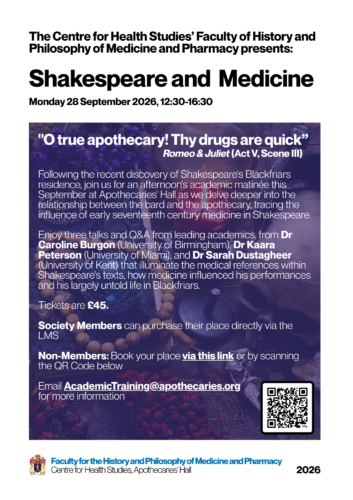
Shakespeare and Medicine
Date: Monday 28 September 2026
Time: 12:30-16:30
Who can attend: Open to all
Cost: £45
Dress code: Casual
Organiser: Matt Scudder AcademicTraining@apothecaries.org
Members’ Portal (LMS): Click here to book
Non-members: Click here to book
Shakespeare & Medicine
‘O true apothecary! Thy drugs are quick”
Romeo & Juliet (Act V, Scene III)
Following the recent discovery of Shakespeare’s Blackfriars residence, join us for an afternoon’s academic matinée this September at Apothecaries’ Hall as we delve deeper into the relationship between the bard and the apothecary, tracing the influence of early seventeenth century ‘Medicine in Shakespeare’.
Enjoy three talks and Q&A from leading academics, from Dr Caroline Burgon (University of Birmingham), Dr Kaara Peterson (University of Miami), and Dr Sarah Dustagheer (University of Kent) that illuminate the medical references within Shakespeare’s texts, how medicine influenced his performances and his largely untold life in Blackfriars.
Caroline Burgon is a PhD researcher at the Shakespeare Institute, University of Birmingham. Her work explores the medical references in Shakespeare’s plays, what they reveal about contemporary ideas of illness, medicine, and the body, and how those ideas would have been understood by Shakespeare’s audiences. Caroline also researches how performances through history have reinterpreted Shakespeare’s plays and characters to reflect changing medical knowledge and attitudes towards illness.
Dr. Kaara L. Peterson is a Visiting Fellow at the Warburg Institute, University of London through 2027, following a term as the Burghley Fellow at St. John’s, Cambridge University (2024). Her new projects explore the intersections of Renaissance visual and material culture, medical and natural history, and literature. Peterson’s latest monograph, A Natural History of Queen Elizabeth I: Embodiment, Portraiture, and Renaissance Culture, is pending contract, and reinterprets the “virgin queen’s” body natural through the lens of Galenic humoralism, which today’s talk draws on. Her first monograph was titled PopularMedicine, Hysterical Disease, and Social Controversy in Shakespeare’s England (Ashgate) while more recent publications include Humorality in Early Modern Art, Material Culture, and Performance (co-edited with Amy Kenny, Palgrave/Macmillan)
Kaara’s talk ‘Shakespeare’s Melancholy Princes: Hamlet and the “Virgin Queen” will focus a more specifically on earlymodern medical history, namely Galenic melancholy in Shakespeare’s world, including its depiction in citizen portraits, in Hamlet, and in a portrait of Queen Elizabeth, along with some attention to the queen’s medical “case history.”
Dr Sarah Dustagheer is Reader in Early Modern Literature at the University of Kent and Head of the School of Humanities. Sarah researches playwriting, performance and theatre space in early modern London, as well as contemporary Shakespearean performance. She is Series Editor for Revels Plays Companion Library (Manchester UP). She is the author of Shakespeare’s Two Playhouses: Repertory and Theatre Space at the Globe and Blackfriars, 1599-1613 (CUP, 2017; shortlisted for Shakespeare’s Globe Book Award 2018), author of Shakespeare and London: A Dictionary (Bloomsbury, 2021); co-author of Shakespeare in London (Bloomsbury, 2014) and co-editor of Stage Directions and the Shakespearean Stage (Bloomsbury, 2017). Her essays on early modern playwriting and theatre space and contemporary Shakespearean performance have appeared in Shakespeare Jahrbuch, Literature Compass, Cahiers Élisabéthains and Shakespeare Bulletin. Sarah’s current project is a history of Shakespeare and the British Empire, funded by a British Academy Midcareer Fellowship; and she is co-editing The Oxford Handbook to Christopher Marlowe with Kirk Melnikoff and Katherine Walker.
Refunds, minus a £5 admin fee (per ticket), will be offered, upon request, to anyone cancelling for any reason up to six working days before an event. After this time, no refunds are available.